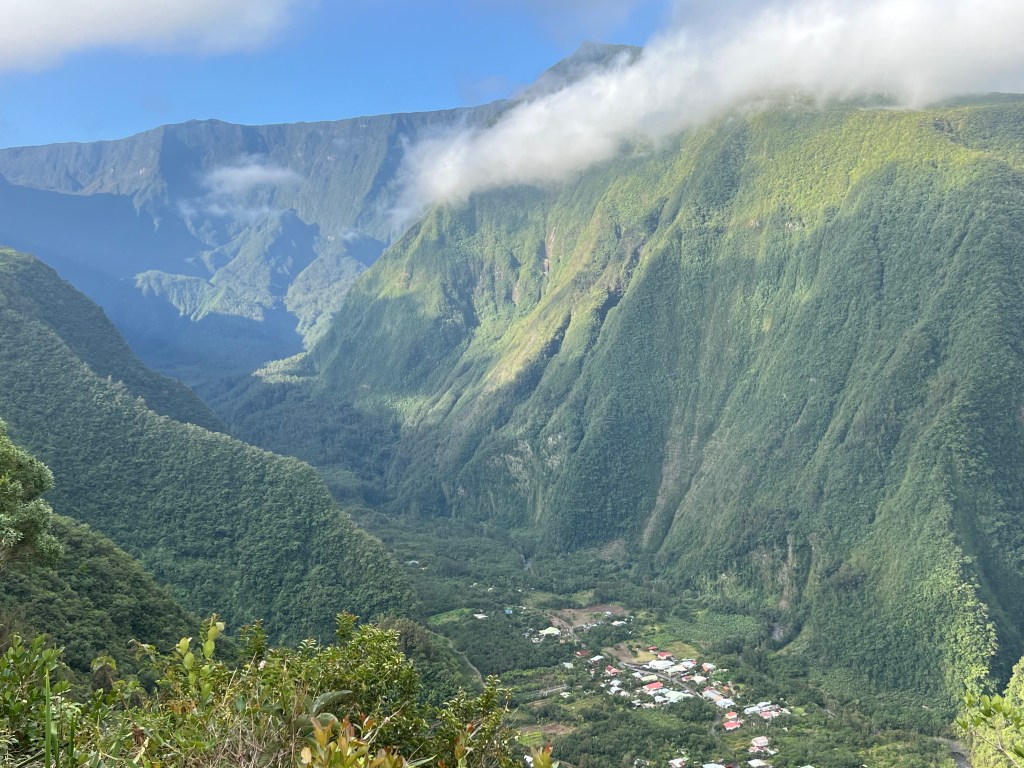
We had heard that the island of Reunion, our last stop before Madagascar, was a can’t-miss-stop on our trip across the Indian Ocean. Has that ever been true! Unlike the islands of Rodrigues and Mauritius, which are an independent country, Reunion is a part of France and feels like a tropical version of the country. They use the Euro, Google Translate is a must, the baguettes, cheese and delicious French butter are top notch, and if you want inexpensive French wine, it is plentiful in the enormous hypermarkets. We’re also driving on the right side of the road for the first time in a year and a half. While it’s been fun to feel like we’re getting a little taste of Europe, the most breathtaking part of our time here has been the terrain of the island. It’s unlike anywhere we’ve ever been or anything we’ve ever seen and we can’t stop saying “wow” as we travel from one stunning spot to another.
The island is marked by an active volcano, Piton de la Fournaise (below), at one end, where you can hike 500 feet down the sheer wall of the caldera, across old lava flows to climb another 500 feet up the side of the peak. The drive to the beginning of the hike takes you from sea level to 7,700 feet high, with more stunning views along the way. Just be careful you don’t drive off the side of tiny, winding road! From lush green tropical terrain at the beginning of the drive, you eventually travel through a barren landscape, Plaines des Sables, that looks just like Mars. Just Google it and you’ll find pictures of both side-by-side and it is eerie how identical they are.
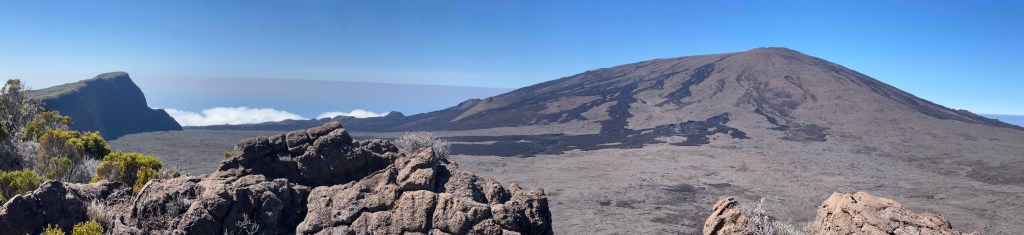
We weren’t sure our kids could handle the entire six-hour roundtrip hike to the peak of the volcano, so we decided to try and just make it the base and back, which would still take about three hours. They were amazing, with great attitudes, and tackled it easily—though both agreed they were ready to turn around at the base and weren’t interested in going all the way to the top.
With that successful hike under our belt, we decided to try exploring Piton des Neiges, the remains of an inactive volcano that formed the island, on another day. We chose a hike with stunning views that was listed as intermediate online. Again we ascended to about 7,000 feet, driving carefully on narrow, twisty roads. When we arrived, we had some doubts when the trailhead was marked with a sign that said “difficile” and featured logos showing falling rocks and a stick figure holding onto a stick figure child, keeping him from tumbling over an edge. Seemed like this might have been mis-marked online?
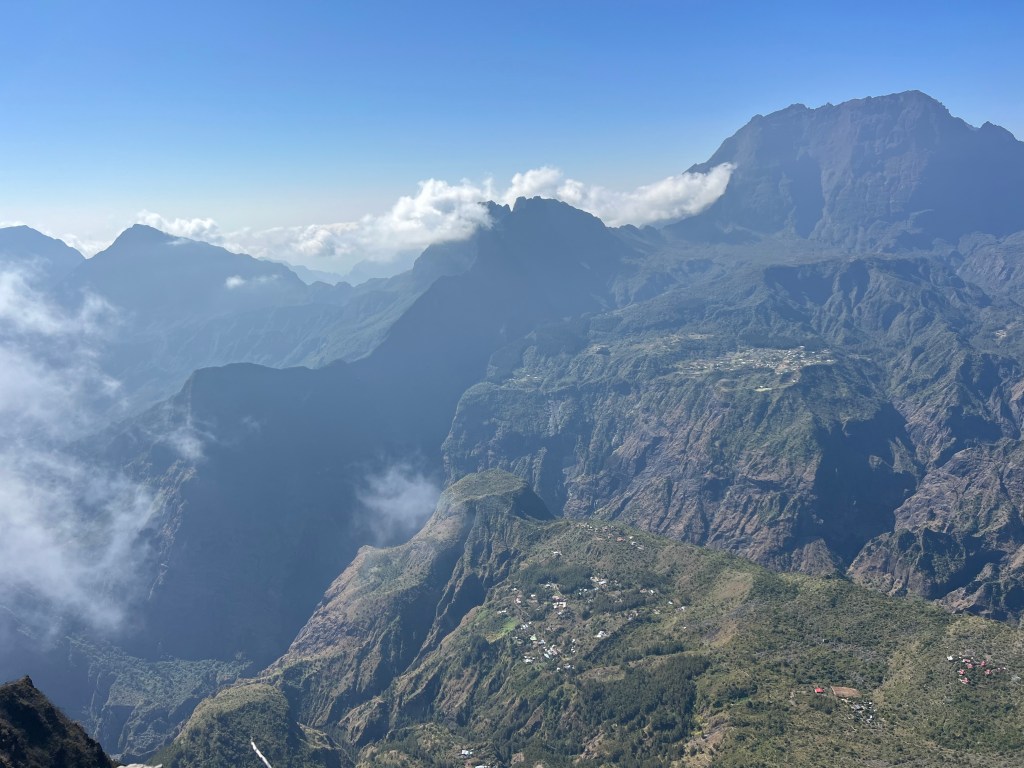
We headed across the field to where the trail started down the sheer wall. We got maybe 20 feet into it before deciding this was definitely not for us. It was terrifying—super high up, sheer drop-offs and a trail that made our stomachs lurch just looking at it—and with no room for error. Mis-marked for sure. We rallied, found another nearby trail that still offered decent views, but without the potential for plunging to our deaths.

In between school and work, we’ve also visited a tea estate and saw tea being harvested, took in the sights and smells (vanilla!) of the island’s biggest fresh market, and visited a rum distillery and sugar factory. We haven’t lacked for things to do and see. The only drawback to the island is that it’s not really set up to explore by boat. Because of the topography, there are no shallow areas to anchor and your only option is to stay at one marina, on a concrete wall, near the industrial port. Then to explore, you need to rent a car, as there is nothing to walk to and the bus system is unreliable. All told, it costs nearly $100 USD a day to stay here, just between car rental and docking. Certainly worth the cost to see this incredible island, but we’re looking forward to being back on anchor in Madagascar!



 SAILING SV ATLAS
Leave a comment