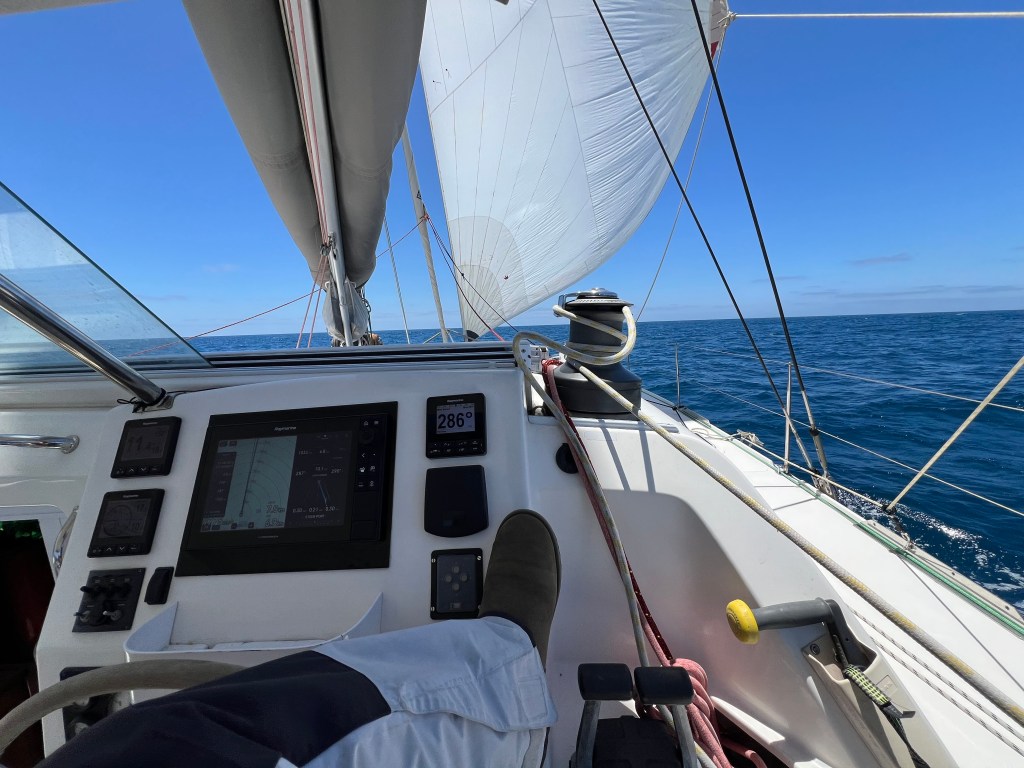
The day after Christmas, we planned to leave Namibia to start our Atlantic crossing, but as Brian ran through his pre-departure checks on Christmas Day, he discovered the autopilot wasn’t working. Cue everything else coming to a halt while we spent two hours troubleshooting and trying to figure out why without any luck. Clearly, we wouldn’t be leaving the next day. We set the tools down and headed off as planned to meet other cruisers for a Christmas dinner braai (BBQ). When we returned later that evening, Brian flipped on the autopilot one more time. It was working.
The next day, he ran through all the electrical connections, making sure they were clean and securely attached. He flipped it on and off multiple times. Everything was in working order. A mystery. Not terribly reassuring before sailing 5,000 nm across an ocean. If it was as simple as buying a new part the next day and then leaving, we would have done it. But getting a spare (that we might not even need) in Namibia meant having it shipped in from South Africa, where everything was closed through the New Year. This would have meant at least a two-week delay. We opted to trust that it was a blip and proceed as planned—albeit one day late.
We’re now seven days into our passage and, thankfully, the autopilot has (knock on all the wood) been working just fine. This passage has found other ways to test us instead. Our first leg, from Namibia to St Helena, is about 1300 nm and it will go down as the slowest we’ve had so far when we (hopefully) arrive tomorrow after eight days at sea. The wind has been light and from mostly behind us, often giving us apparent wind of 4-6 knots. We’ve had up just about every sail combination we could think of to keep the boat rolling in the right direction, but with speeds of only 4 or 5 knots. For comparison, we usually passage plan conservatively at 6.5 to 7 knots average and our fastest passage saw us average 8.5 knots.
Off-watch hours have often been interrupted by sail changes to try and eke out every last drop of sailing speed, meaning less sleep for the crew as a whole. The flip side is that it has been fairly comfortable, allowing for schoolwork, board games, and even some movies for the kids. The one other positive has been the warmer night watches. When we left Namibia, I was wearing multiple layers under my full foul weather gear, plus gloves, a hat, and occasionally wrapped up in a blanket to boot—it was cold! Now further north and west, I’ve ditched the blanket, hat, and gloves and have only one layer under my foul weather gear.
We’re currently about 24 hours out from St Helena and we’ve finally given in, put the sails away and are motoring in flat seas with very little wind. It’s a very different experience than the Indian Ocean crossing where we simply reefed the sails and then held on for the (fast) ride! But with another roughly 3,700 nm to go to Barbados, we know that we can’t motor the whole way there and we don’t want to either. We need to be judicious in our use of fuel. With full tanks, we can motor for 11 days or about 1,650 nm. We plan to spend three days in St Helena, before heading off another 1,700 nm on the next leg to the Brazilian island of Fernando de Noronha.
We’ll top off our fuel in St Helena (at a truly painful price of around $9.50 USD per gallon!), then hopefully have better luck with wind on our next two legs. Passages are a lesson in patience and I think we will be exceptionally patient people by the time we get to the Caribbean!

 SAILING SV ATLAS
Leave a comment