Ah, the eternal cruisers’ debate. I don’t know if I’ve ever seen more lengthy threads full of strident opinions than when someone asks “cat or mono?” in a cruising Facebook group. We’ve now owned and sailed both for fair amounts of time and miles. After we sold our racing boat and bought a cruising boat, we spent seven years as the owners of a Jeanneau 45DS. We sailed up and down Lake Ontario, cruising to the Thousand Islands each summer. We left Toronto on that boat in July 2021 and sailed down the US East Coast to Florida, then the Bahamas. We adored that boat and we’ve both agreed we would buy it again, but we are so glad we’re doing what we’re doing right now on a cat—although not all cats or monohulls are created equally, of course.
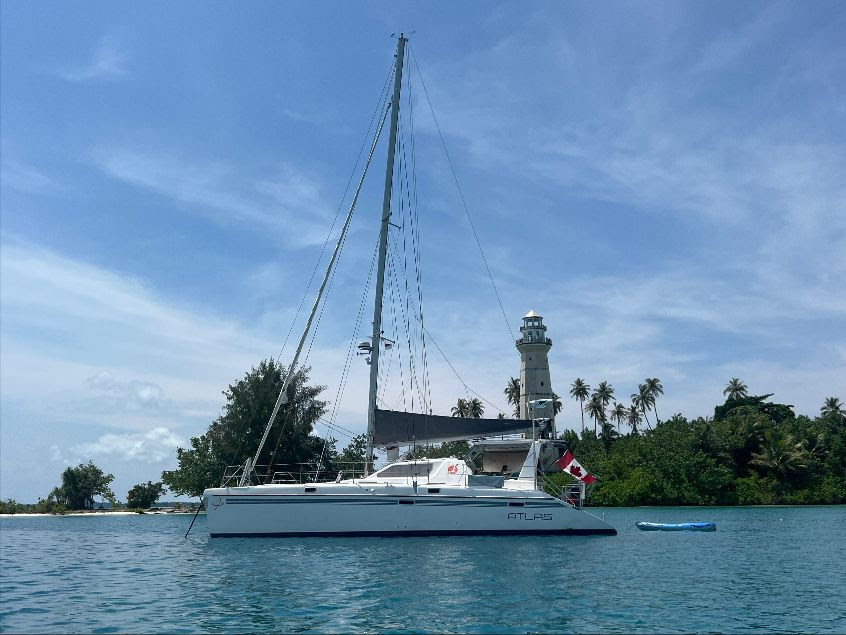
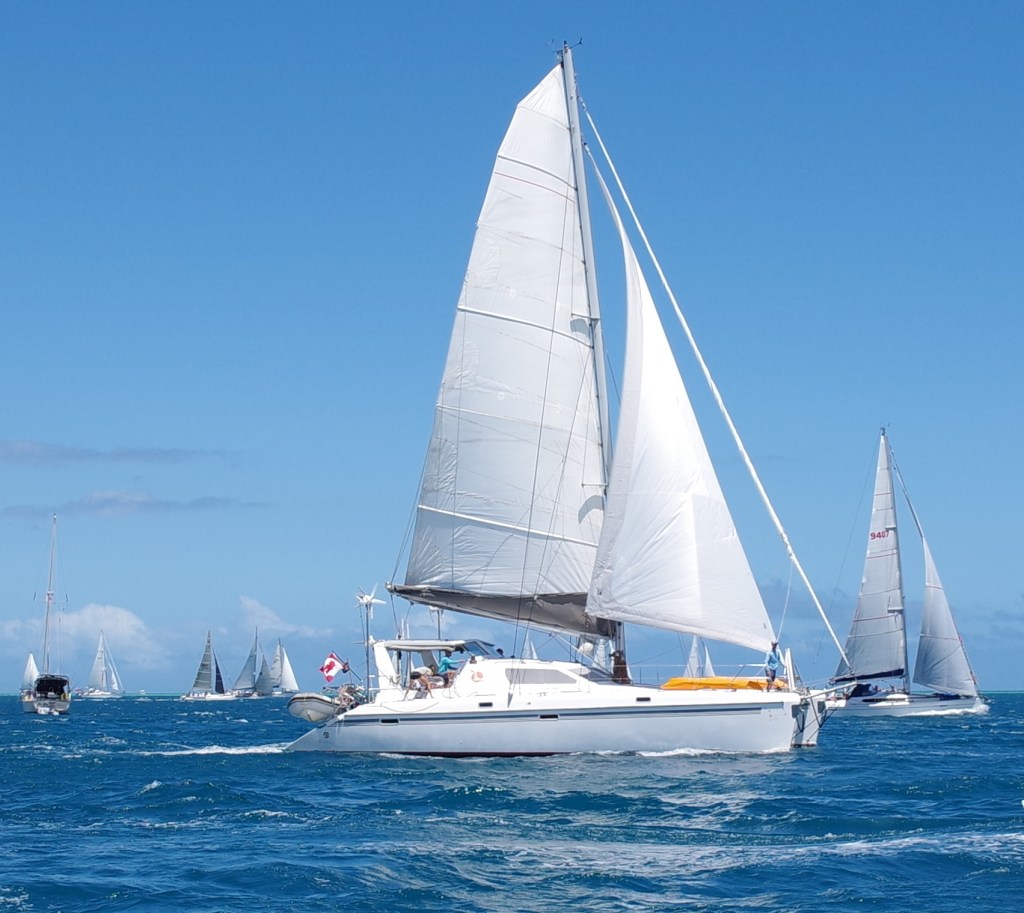
Our cat, a St Francis 50, is not the typical condo-maran that you would charter in the Caribbean. It’s a South African-built, semi-custom boat made for bluewater ocean cruising. After sailing 22,000 miles and crossing two oceans, I can say that it absolutely achieves what the designer, Angelo Lavranos, set out to do. It’s robust, sails well, offers all the tankage and redundancies that you would want for crossing oceans, while also offering a comfortable, spacious platform to live on. All that being said, it’s a tool for a job and when we return to coastal cruising or sailing on the Great Lakes, we won’t be doing it on this boat.
What We Love About Cat Life
* The Stability — We’re still sailing and it’s still wavy, so it’s not a panacea, but generally the ride is much more comfortable than on a monohull, especially when the wind is aft of the beam. Riding dead downwind, or close to it, being pushed along by the waves and wind is pretty close to heaven on a passage. We all still talk about a particularly fantastic day going downwind in the trades from New Caledonia to Australia. Even with 6-9 foot following seas and wind of 20-28 knots, we reefed the sails to slow from 10 knots to 8 knots and enjoyed a full brunch our French crew put on in the cockpit. On the second leg of our Atlantic crossing, we spent 13 days with light winds from behind and relatively small waves. The comfort and ease of this passage allowed the kids to spend days building massive LEGO creations, doing schoolwork (to their chagrin), and I was able to make regular meals. Of course, that’s just on passage. At anchor, the cat also wins hands down. There have been many times we’ve been in marginal anchorages, watching monohulls rock dramatically from side-to-side in the swell, and been so grateful for our two hulls.
* The Storage — When you’re crossing oceans or spending time in remote areas without easy access to provisions, the storage on a catamaran makes life much easier. In addition to lots of storage compartments for shelf-stable groceries, we also have a giant chest freezer that could house a child, and two good-sized refrigerators. The trick is trying to remember where you put those black beans or that jar of mayo.
* Sailing — This boat continues to impress us with its speed. We’re often reefing sails and trying to slow it down, as we tend to sail more conservatively. It’s not a carbon fiber cat and we can’t match their speeds, but we passage plan at 7.5-8 knots and regularly hit 8-10 knots—which feels plenty fast surfing down waves in what is essentially our house. On our most recent passage, we were very pleased with the speed we were able to manage in lighter winds. At one point in 8-11 knots of breeze from behind us, we were still managing 5-6 knots of speed with our spinnaker up. With 8-11 knots from forward of the beam, we sail 7-8 knots. Even going upwind, with enough breeze, we can point as high as 50 degrees, which matches what we were able to do in our shoal-draft monohull.
* Redundancies & Tankage — One of the arguments against cats is having more maintenance to do with two engines. Having spent almost three years doing maintenance on the engines, I can say without a doubt that I much prefer having two and the extra maintenance time is minor. Knowing that if one engine fails, we have another is a great reassurance when you’re in remote areas away from parts. In addition to the extra redundancy of two engines, a catamaran like ours is also built with extra tankage. We have a large water tank in each hull, with separate water pumps. If something happens on one side—contamination or a pump failure—we can use the other side. We also carry 880 liters/233 gallons of diesel in four inline tanks, which gives us a rough motoring time of 12 days or a distance of 1,750 nm.
* The Space — I’ve said many times that I could live in this amount of space for the rest of my life with no problem. It is roomy enough that you can retreat somewhere on the boat if you need some time away from your family (I would never…). There’s ample space in the gathering areas of the salon and cockpit, both for daily living as a family of four or hosting other families and kids aboard for dinner or a movie night. Even the galley has enough counter space that I’ve been able to cook two Thanksgiving dinners and a Christmas dinner without ruing the fact that I’m doing it on a boat—although I could use a slightly larger oven.

Why We’ll Probably Have a Monohull Again
* Ease of Hauling and Service — We would never take a boat like a St Francis 50 back to the Great Lakes or keep it as a daysailer/weekend cruiser once we’re no longer full-time, liveaboard cruisers. It’s too much boat. Plus, finding facilities that can manage a boat this big outside of the typical cruising routes is difficult. Additionally, since we don’t need the extra space, paying double for things like bottom paint makes no sense.
* Easy Sailing — While we love sailing this boat on longer passages, we’re not interested in taking it on a daysail. On our Jeanneau, we had in-mast furling which made it so easy to go out for a sail when the weather was nice or to take out friends. Everything was easy to handle, even if it was just one of us. On this boat, everything is much bigger, with more load on the sheets, sails, and winches. It takes more effort to get going and more monitoring while underway—and most maneuvers require at least two of us.
* Heeling — While I’m not interested in heeling for 2,000 miles across an ocean, I’ll happily do that on shorter stints closer to home in order to get that feel of charging through the water on a monohull. There is a different feel to sailing a monohull that just isn’t replicated on a cat, which has a more frenetic motion. As lifelong dinghy/monohull sailors, it was an adjustment—albeit a fairly quick one—when we moved onto this boat.
So back to that eternal cruisers’ debate: cat or mono? For us, it’s clearly a cat, hands down. Having done that initial seven months of our trip to the Bahamas on a monohull, then switching to a cat for the last three years, there is no better, more comfortable platform for cruising than on a catamaran.


 SAILING SV ATLAS
Leave a comment